Welcome to ACPN 2026 in Thailand
Thailand in brief
The “Land of Smiles” blends centuries-old heritage with modern convenience: lush national parks and tropical coastlines sit alongside advanced healthcare, robust transport, and a dynamic economy. Thai is the official language, the Thai Baht (THB) is the currency, and the country operates on Indochina Time (UTC+7) year-round—no daylight saving time.
Bangkok in brief
Bangkok (Krung Thep Maha Nakhon) is a global hub—think cutting-edge conference venues, award-winning cuisine, and easy city mobility. Two international airports serve the capital (Suvarnabhumi and Don Mueang), rapid transit whisks you between districts, and riverside neighborhoods offer a serene counterpoint to the downtown skyline.
Getting here
- Primary gateway: Suvarnabhumi Airport (BKK)—Thailand’s largest international airport—links Bangkok to major cities across Asia, Europe, the Middle East, Oceania, and North America.
- Secondary hub: Don Mueang International Airport (DMK) serves extensive regional and low-cost networks across Asia.
- Flag carrier: Thai Airways International connects Bangkok with key long-haul and regional destinations and offers integrated domestic links.
Visa & Entry
- Visitors from 93 countries and territories are automatically granted permission to enter the Kingdom of Thailand.
https://image.mfa.go.th/mfa/0/zE6021nSnu/0303/%E0%B8%9C.60.pdf - Additional of 31 countries can apply for a “Visa on Arrival” at the Immigration Hall in all Thai international airports and border checkpoints. Visas can be obtained from the nearest Royal Thai Embassy or Consulate.
https://image.mfa.go.th/mfa/0/zE6021nSnu/0303/VOA.pdf - Starting January 1, 2025, citizens of countries requiring visa to enter Thailand, will benefit from a more streamlined process as the Ministry of Foreign Affairs launches an e-visa service. Available across 94 Royal Thai Embassies and Consulates worldwide, the service can be accessed via www.thaievisa.go.th The website provides information on the application process, visa categories, and related terms and conditions.
Getting around Bangkok
- BTS Skytrain & MRT Subway: Fast, air-conditioned rail lines covering the business core and major attractions; easy transfers with stored-value cards.
- Airport Rail Link (ARL): Direct train from Suvarnabhumi Airport to downtown (Phaya Thai), typically ~30 minutes, operating roughly 05:30–24:00.
- Taxis & ride-hailing: Metered taxis are plentiful; ride-hailing apps are widely used for transparent pricing.
Do’s & Don’ts (cultural etiquette)
- Dress modestly at temples (cover shoulders/knees); remove shoes before entering sacred buildings.
- Greet with a “wai” (palms together, slight bow) and speak calmly; avoid touching anyone’s head or pointing feet at people or Buddha images.
- Be respectful of the monarchy and religious sites; follow posted rules (e.g., Grand Palace dress code).
Fast facts & figures
- Geography: Thailand is located in the center of Southeast Asia sharing common borders with Malaysia, Myanmar, Lao PDR and Cambodia
- Currency: Thai Baht (THB). ATMs are widespread and cards are widely accepted in urban areas.
- Time zone: UTC+7 (ICT), no daylight saving time.
- Electricity: ~220–230V, 50Hz. Sockets commonly accept flat (Type A/B) and round (Type C) pins.
- Business hours: Government/office hours typically Mon–Fri, ~08:30/09:00–16:30/18:00; shopping malls generally 10:00–22:00 daily.
- Weather: Tropical. Bangkok is warm year-round (often 25–35°C / 77–95°F), with a cool/dry season Nov–Feb, hot season Mar–May, and rainy season Jun–Oct.
- Language: Thai is official; English widely spoken in hotels, airports, and retail.
- Emergency numbers: 191 (police), 1669 (medical), 199 (fire), Tourist Police 1155 (24/7 multilingual support).
- VAT Refund: Visitors entering the Kingdom on a tourist visa are entitled to a refund of 7% V.A.T. on goods purchased at registered retails outlets displaying “VAT Refund for Tourists” signs.
Pedestrian Safety in Bangkok
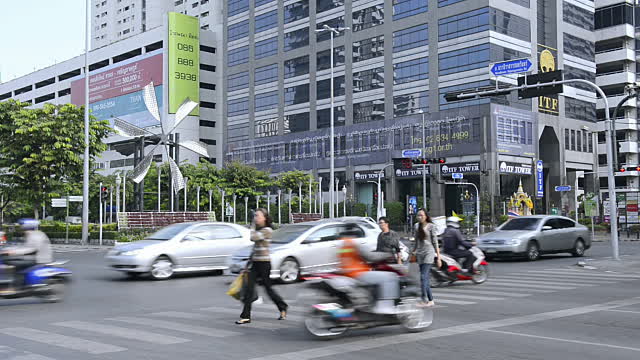
In Bangkok, sometimes the fastest way to get from one place to another is to walk. But in a city notorious for accidents and injuries, here are 7 points to keep in mind when out and about on city streets, especially with little ones in tow.
1. Be aware of motorbikes, everywhere. Bikes don’t always follow the general direction of traffic; they can often be seen going against traffic illegally. They also drive on footpaths to avoid heavy road activity. Whether you’re on a main road or in a small soi, make sure that there are no bikes coming from any direction before crossing the street.
2. Always assume that motorized traffic will not stop for pedestrians, even children. It doesn’t matter if you’re at a zebra crossing or a designated pedestrian crossing with illuminated “walk” lights, don’t step onto the street until you are sure that oncoming vehicles will slow to a stop. Also, in Thailand, flashing headlights from a car usually serves as a warning that the driver does not intend to slow down or stop.
3. Use elevated pedestrian bridges when possible. They may require a little more effort, but pedestrian overpasses are safer for getting across roads with fast-moving traffic. With access to both sides of the street, BTS and MRT stations are also great for crossing the road or busy intersections. Some even have elevated paths (like the one connecting Chidlom and Siam), and elevators, which are useful for prams, but you may have to request access from the station staff.
4. Watch out for bus lanes. On some Bangkok streets, buses have a designated lane where they may be driving in an opposite direction to vehicles in other lanes. Again, always look both ways before crossing or seek out the nearest pedestrian overpass.
5. Be wary of turning vehicles. At intersections, scan over your shoulder for turning cars. They may or may not have right of way – just make sure you’re able to gauge the driver’s intent before crossing. Also, poorly designed turns, misplaced planters, advertising banners, etc, can block a driver’s visibility.
6. Walk facing traffic on streets with no sidewalks. This is safer as you can establish eye contact with approaching motorists and make quicker judgments concerning your family’s safety.
7. Wait to cross roads with other people, especially when you’re in doubt. The premise of “safety in numbers” rings true on Bangkok streets.